

Much of the work in the anti-slavery movement has been directed at convincing businesses fixated on profits to investigate (and address) abuses hidden in their supply chains. But some businesses are starting off on a much better foot, with a more pro-active approach to do social good.
In fact, some are building their entire business model to prove that it can be done without exploitation and abuse. Social entrepreneurship is a growing trend. These start-ups combine a big heart with a head for business, using the engine of commerce to drive positive change.
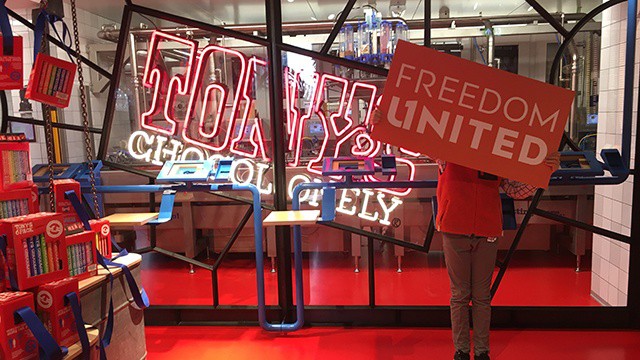
One company, Tony’s Chocolonely, is doing this in an industry with an unfortunately bleak history of exploitation. While for most of us it prompts sweet memories of childhood, chocolate has a dark and troubling history of slavery. The key ingredient cocoa – 70% of which is sourced from West Africa – is often produced by children working in hazardous conditions and in some cases by children trafficked into forced labor.
Efforts to get large global chocolate companies to address the issue have met with mixed results. This is what makes Tony’s Chocolonely unique in the industry. They don’t just want to make slave-free chocolate. They want to make slave-free chocolate the industry standard. They want to show the world that it’s possible to make slavery-free chocolate and be commercially successful.
Tony’s is developing a new standard of practices and tools, so other companies will have a roadmap to sustainable, slavery-free production practices. These include implementing the Child Labor Monitoring and Remediation System (CLMRS) and gathering social data to determine whether, where and why child labor is being used. Their “Beantracker” provides data on which farmers supplied what percentage of each shipping container of beans, making their approach feasible for the rest of the chocolate industry.
There is still much work to be done on rallying the business community against labor trafficking and modern slavery in supply chains, in a variety of different industries. But fortunately, there are progressive companies like Tony’s Chocolonely, built on social entrepreneurship and providing an inspiring example. If it can be done in the chocolate industry, it’s a solid proof-of-concept that business can create change towards ending exploitation in any industry.





-
Follow us on Facebook
5.6M
-
Follow us on Twitter
32K
-
Follow us on Instagram
8K
-
Subscribe to our Youtube
5.7K
Donate