


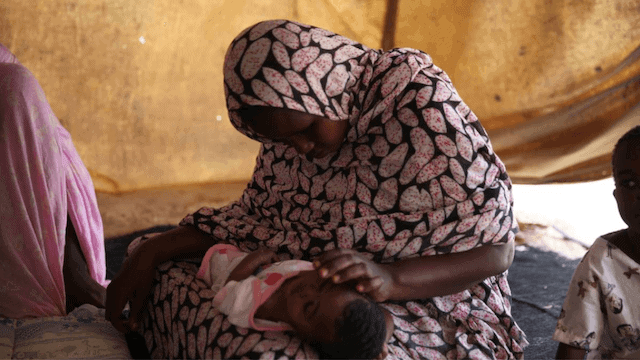
One day a driver saw Mbarka Mint Essatim doing heavy lifting and asked if she was being paid. When she responded no, the man told her the truth about her situation — she was enslaved by the very family she had considered her own.
She was 23, and despite neither looking like her “masters” — members of the light-skinned elite known as white Moors — or being treated like them, she said “I knew no one else and thought they were my family.”
“I did not sleep with them in the same house. I was afraid of them, they struck me … raped me. I wanted to be like children my age, going to school and studying. I was alone.”
The driver, now Essatim’s husband, helped her escape, but with seven children, no job, and no education, it is a struggle for her and countless other freed slaves to survive.
Thomson Reuters Foundation reports:
Although it is hard to identify victims – countless remain hidden within mansions – former slaves are easy to spot.
Rights groups say they amass in the poorest areas, often lacking running water, health centres and schools. Charities and government help, but reach just a fraction of those in need.
From her moment of liberty, Essatim said she was on her own.
“I was happy to be free… (but) I wanted to have a house to live in, and work for me and my husband,” said the 30-year-old.
She still has neither.
Mauritania’s government insists that slavery is largely a thing of the past and that cases are dealt with swiftly. Yet to date there have only been four prosecutions of slave owners since 2007.
On top of this, anti-slavery activists point out that after victims are freed from their masters, the state has done little to help them get back on their feet.
“For the slaves, all we can do is free them,” said Alioune Sow, a member of the Initiative for the Resurgence of the Abolitionist Movement (IRA), which freed Essatim’s children.
“We are not the state. We don’t have funds,” said pharmacist Sow, who donates medicine to ex-slaves when he can.





Freedom United is interested in hearing from our community and welcomes relevant, informed comments, advice, and insights that advance the conversation around our campaigns and advocacy. We value inclusivity and respect within our community. To be approved, your comments should be civil.