
The US immigration detention population has reached a staggering record high of 73,000
people—an 84% increase on 2025 and it’s expected to continue reaching new highs.1 The US government has reportedly set a quota of 3,000 arrests per day.
Ninety percent of these people are funneled into overcrowded and unsanitary facilities owned
and operated by private prison corporations. Survivors have reported physical, verbal, and
sexual abuse, while woefully inadequate medical care and neglect have led to preventable
deaths.2
Many are forced to clean, cook meals and perform essential labor to keep detention centers
going despite being profit-making corporations. The people detained make little to no pay but if
they refuse to work, they risk solitary confinement, loss of visitation, or retaliation that can
affect their immigration cases.
“Unprecedented opportunities” for profiting from forced labor
The US public and private prison and immigration detention industry has long been built to
exploit profit from those who are behind bars, in some cases under threat of punishment or
penalty, in contravention with international standards. One of the main partners working with
Immigration and Customs Enforcement (ICE) is GEO Group, a corporate prison giant whose
leadership sees skyrocketing immigrant detention as cause for celebration.
In 2025, on a quarterly earnings call, GEO Group CEO, J Donahue told participants, “the scale of
the opportunity before our company is unlike any we’ve previously experienced.”3 Founder and
Executive Chairman, George Zoley boasted that GEO Group is “the single largest contractor to
ICE.” He shared that he was extending the end of his contract from 2026 to 2029 due to
“unprecedented growth opportunities.”
In fact, the company gave both Zoley and Donahue massive raises in 2025, increasing their
bonuses from 100% to 150% of their base salaries (of $1.1 million and $1.1 million respectively)
“in light of the unprecedented business opportunities that the Company is experiencing.”4
These bonuses are tied to the company’s net income and, in a detention center, the fastest way
to increase net income is to cut costs.
By their own estimates, if GEO Group was forced to hire actual employees to do all the essential
work to keep their centers running, they would need to hire at least 85 full-time staff per
facility.5 Instead, they use the threat of punishment to make the detainees do it for free.
A business model built on threats and debt
“We had no safety training, no protective gear—only punishment if we refused.”
— Former detainee held in a GEO Group facility6
To GEO Group, the tens of thousands people currently in the system aren’t human beings—they
are units of revenue. For essential roles like cooking thousands of meals or processing industrial
laundry, GEO pays just $1.00 per day. In 2026, this rate is 1/60th of the federal minimum wage.
At the same time, GEO inflates the cost of survival inside its walls, charging up to $11.02
for a single tube of toothpaste. By price-gouging the very people it refuses to pay, GEO creates a
trap where detainees must work for nearly 2 weeks just to afford the basics.
Because of small amounts of food, ACLU reported, “some detainees began to work in the
kitchen just so they could eat more…. one detainee lost 68 pounds.” Their “volunteering,” in
other words, involved literally working for food.7
Under ICE’s National Detention Standards, work assignments are strictly voluntary. Detainees are only required to perform personal housekeeping, such as making their own beds and keeping their immediate living area clean. But GEO pretends forcing immigrants to work is part of a “voluntary work program” while avoiding hiring staff at market wages. GEO has used this unsavory practice as a defense in one case claiming,
“Because of the labor provided to GEO by the detained workers employed under this program,
GEO operated its facility with just a handful of full-time staff hired from the local area, thereby
saving millions of dollars that it would otherwise have spent on payroll.”8
“Voluntary” work detainees cannot refuse
Courts, advocates, and survivors have exposed the “work program” for what it is time and time
again:
– In the landmark Menocal v. GEO Group litigation, detainees testified that GEO’s “Housing
Unit Sanitation Policy” was used to force uncompensated labor. Those who refused to
scrub showers or buff floors were threatened with solitary confinement and the loss of
phone access to their families and legal counsel.
– In late 2025, a harrowing report from the South Louisiana ICE Processing Center detailed
how queer and trans detainees were recruited into “unsanctioned” work programs,
forced to move heavy cinder blocks and handle industrial chemicals without protective
gear, often facing physical abuse if they resisted.9
– In Raul Novoa v. the GEO Group, in addition to the threat of solitary or facing criminal
prosecution, detainees reported GEO depriving them of food, water and hygiene
supplies to force them to work to be able to purchase them.10
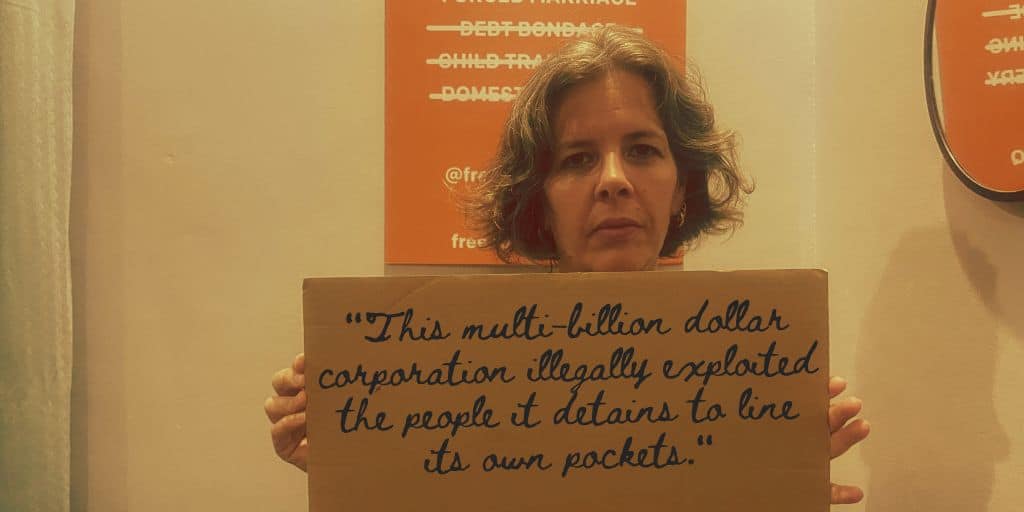
In 2021, in Nwauzor vs. GEO Group, federal judge Robert Bryan found that GEO had enjoyed
“unjust enrichment” through unfair labor practices, noting:
This multi-billion dollar corporation illegally exploited the people it detains to line its own
pockets.11
Undermining national anti-trafficking protections
Several lawsuits have been brought against private immigration detention centers over claims of
human trafficking. Federal courts in multiple states have ruled that these corporations can
be held liable under the Trafficking Victims Protection Act (TVPA). The TVPA explicitly prohibits the
use of forced labor through the abuse of legal process or threats of serious harm.
Rather than ending these practices, prison corporations haves spent years arguing they should be immune from accountability. This battle has reached a boiling point at the Supreme Court, where GEO Group is currently desperately fighting for the right to violate to anti-trafficking protections.12
Under the 13th Amendment of the US Constitution, involuntary servitude remains legal as
punishment for a crime, which Freedom United is challenging. However, these people are not
serving criminal sentences and they are still being subjected to forced labor. Many have been taken
into custody while following the law—during civil immigration proceedings. Many are survivors
of human trafficking,13 legally allowed to await decisions on their visa applications in the US.
As more and more people are detained, forced labor inside detention centers will only grow unless it is stopped.
We are not arguing against work programs in detention centers. We are exposing and calling for
an end to forced labor programs in detention centers.
All local governments and private companies to comply with the TVPA. Let’s end all profiteering from forced labor in detention centers.
Join our call and help send a strong message to GEO Group. They can’t get away with forced labor behind bars!
Notes:
- https://www.cbsnews.com/news/ices-detainee-population-record-high-of-73000/#:~:text=As%20of%20Thursday%2C%20ICE%20was,40%2C000%2C%20the%20internal%20statistics%20show ↩
- https://www.vera.org/news/the-truth-about-immigration-detention-in-the-united-states ↩
- https://theappeal.org/geo-group-earnings-mass-deportations/ ↩
- https://investors.geogroup.com/static-files/5520606c-df51-4bf2-8331-d500c3a4e798 ↩
- https://www.brennancenter.org/our-work/analysis-opinion/private-prison-company-seeks-new-hearing-wages-immigrants-detention#:~:text=GEO%20Group%20estimated%20that%20if,detainees%20conducted%20at%20the%20facility ↩
- https://davisvanguard.org/2025/04/forced-labor-detained-immigrants/ ↩
- https://www.thenation.com/article/archive/ices-captive-immigrant-labor-force/ ↩
- https://caselaw.findlaw.com/court/us-9th-circuit/116874882.html ↩
- https://www.theguardian.com/us-news/2025/oct/16/ice-immigration-queer-trans-louisiana ↩
- https://www.freedomunited.org/news/exploitative-immigrant-detainee-labor-saves-for-profit-prison-47-million/ ↩
- https://www.atg.wa.gov/news/news-releases/ag-ferguson-jury-finds-geo-profit-operator-tacoma-ice-detention-center-must-pay ↩
- https://www.brennancenter.org/our-work/analysis-opinion/supreme-court-considers-private-prison-case ↩
- https://www.freedomunited.org/news/trafficking-survivors-abandon-protection/ ↩
 A few things we do not tolerate: comments that promote discrimination, prejudice, racism, or xenophobia, as well as personal attacks or profanity. We screen submissions in order to create a space where the entire Freedom United community feels safe to express and exchange thoughtful opinions.

Make your voice heard
Comment
1
Share this petition