


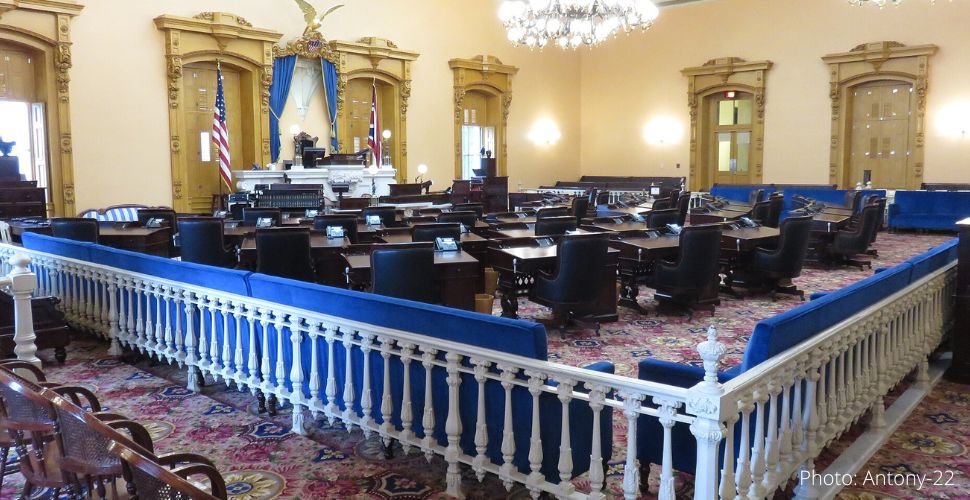
Ohio Senate Republicans move to block a bipartisan bill to end child marriage in Ohio, keeping a law that lets 17-year-olds marry with a judge’s approval. They took the position in a private meeting last week, despite bipartisan support for the bill and the absence of any public opposition.
Survivors and advocates warn that the existing law allowing child marriage can be used to abet trafficking and pressure girls into forced marriage, which they then cannot legally leave.
Closed-door meeting stalls ban on child marriage
Republican Senator Bill Blessing and Democratic Senator Bill DeMora co-sponsored Senate Bill 341, which would set Ohio’s minimum marriage age at 18 with no exceptions. Supporters expected it to pass easily if it reached a vote. Instead, Republican senators decided privately that the existing law was good enough, bringing into question the chance of passing SB 341 into law.
The decision outraged Fraidy Reiss, a child marriage survivor and founder of the nonprofit Unchained at Last.
She told Newsweek:
“Sure, the current law is sufficient for perverts who are into high school girls. It is sufficient for predators who seek to sex traffic girls without fear of prosecution. It is sufficient for abusive parents who are tired of paying child support. It is more than sufficient for legislators who hate girls. As for the rest of us, we demand better. And we will continue to push relentlessly for a marriage age of 18, no exceptions.”
The bill went through five Senate hearings without a single public objection. Some Republican senators pointed to Amish and Mennonite communities to justify their opposition. However, there is no evidence that those communities oppose raising the marriage age.
Michele Hanash, director of the Aha Foundation, which also backed the bill, warned that Ohio’s reputation is now at stake. At a press conference last week she said the state could become known:
“…as the state that had all the evidence, heard all the warnings, witnessed the consequences of child marriage, and still failed to close the legal loophole that leaves children vulnerable to exploitation. Or it can become known as the state that confronted a painful truth and took action to protect its children.”
A legal trap for children
Under current Ohio law, a 17-year-old can marry someone up to four years older if a juvenile court approves and the couple waits 14 days. Marriage emancipates the minor from their parents. In practice, however, married minors usually cannot hire a lawyer, enter a domestic violence shelter or file for divorce.
For Stephanie Lane, that legal trap lasted decades. She married a 31-year-old man at 16, under Ohio’s previous law. She said:
“I could not legally make any adult decisions. He became my legal guardian… What followed was more than two decades of force of control and abuse—emotional, financial, sexual, spiritual.”
More than 5,000 minors married in Ohio between 2000 and 2024, according to state health data cited by Unchained at Last. When a child cannot freely consent to a marriage or safely leave it, that marriage is a form of modern slavery.
Momentum builds as Ohio falls behind
Across the country, 18 US states have now banned child marriage outright, with Oklahoma and California joining this year. As a result, Ohio has faced mounting pressure to follow. If the bill fails, Blessing and DeMora plan to reintroduce it next session. Yet any bill that does not pass by the end of the year must start again from scratch.
The setback for efforts to end child marriage in Ohio also comes as the world marks the first International Day to End Child, Early and Forced Marriage, which the UN declared for November 27.
Every delay leaves more children at risk. Join our campaign calling on all US states to end child marriage, with no exceptions.





Freedom United is interested in hearing from our community and welcomes relevant, informed comments, advice, and insights that advance the conversation around our campaigns and advocacy. We value inclusivity and respect within our community. To be approved, your comments should be civil.
A few things we do not tolerate: comments that promote discrimination, prejudice, racism, or xenophobia, as well as personal attacks or profanity. We screen submissions in order to create a space where the entire Freedom United community feels safe to express and exchange thoughtful opinions.