

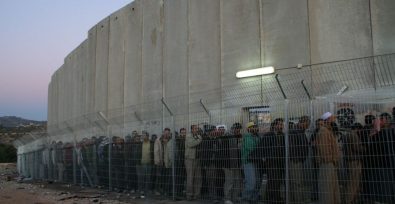
Listen here. When wars dominate headlines, labor exploitation rarely makes the cut. But a new study1 by Dr. Maayan Niezna and Dr. Yahel Kurlander, shows why we need to be paying closer attention to what’s happening to non-citizen workers caught up in the war in Israel and Palestine.
Israel’s economy depends on non-citizen labor
Before October 2023, Israel’s economy relied heavily on non-citizen labor: around 150,000 migrant workers, mostly from Asia and Eastern Europe, and well over 100,000 Palestinian workers from the West Bank, doing the “dirty, dangerous, and difficult” jobs in agriculture, construction, and care that few others would take.
The war upended this system. Migrant agricultural workers near the Gaza border faced direct violence—dozens were killed or taken hostage on October 7.
Meanwhile, more than 140,000 Palestinian workers were abruptly barred from entering Israel, plunging the West Bank into deep unemployment and economic crisis.
An expansion of migrant quotas fueling exploitative recruitment schemes
What followed should concern anyone who cares about labor rights. Rather than restoring Palestinian workers’ access to jobs, the Israeli government moved swiftly to replace them with newly recruited migrant workers—reviving for-profit recruitment practices that had previously been phased out precisely because they fueled debt bondage and exploitation.
Quotas for migrant labor have since tripled, with recruitment now extending into sectors that never relied on migrant workers before.
Niezna and Kurlander argue this isn’t simply about security. It reflects a collision between economic interests, nationalist politics, and the deeper colonial dynamics shaping who is allowed to work, under what conditions, and who is treated as disposable.
With oversight mechanisms weakened and international pressure largely ineffective, workers—both Palestinian and migrant—are bearing significant, underreported costs of this crisis.
A crucial conversation
To explore these findings in depth, I sat down with Dr. Niezna for an hour-long conversation unpacking the research, its implications, and what it reveals about how exploitation takes hold during crisis.
We discuss the politics behind who gets to work, the rollback of worker protections, and why this story matters far beyond the borders of this one conflict.
Listen to the full discussion
A lesson for the rest of the world
This research is a sobering reminder that crisis doesn’t suspend exploitation—it often accelerates it, finding new workers to bear its weight. Understanding these dynamics is essential to building meaningful protections, both in this conflict and beyond it.
What I found particularly striking is how tensions between capitalism, entho-nationalism and colonialism are exposed and that these tensions are familiar in non–crisis contexts. For example, in the US, the sharp increase in migrant child workers whilst child labor protections are being rolled back; and the UK government’s response to businesses’ appeal to address labor shortages—the launch of sector specific visa categories—a response which tries to maintain aggressive immigration targets and leaves workers vulnerable to exploitation.
Dr Niezna’s research doesn’t just explain labor developments in Israel, it also helps frame labor policies developments in other countries.
Before you go…
Thanks for reading! We believe that knowing history helps tackle modern slavery today. Everyone should be have the opportunity to learn about the systems and structures that underpin exploitation which is why our articles are free for all.
Despite this, we are not owned or beholden to government, corporate or other interests. Everything we do—holding the powerful to account, exposing injustice, fighting modern slavery—is funded by readers like you.
If you’re able, please consider chipping in. We value every contribution. But monthly donations make the greatest impact, helping us stay independent as we work towards creating a society where everyone is free.




Freedom United is interested in hearing from our community and welcomes relevant, informed comments, advice, and insights that advance the conversation around our campaigns and advocacy. We value inclusivity and respect within our community. To be approved, your comments should be civil.
There is no genocide in Gaza. Hamas built 500 km of tunnels in the 40km long strip to have an urban war that it thought it could survive and continue massacres from. You saw the thousands on roads and tent encampments – they were not strafed with bullets or bombed. Half those that died were militants involved in killing the Jewish and Muslim Israeli army soldiers in Gaza. Hamas’s Charter is to continue killing Israeli Jews and Palestinians to takeover Israel for an extreme fundamentalist regime
The worst thing about the Genocide in Gaza is that the world has decided not to look. The oppression, torture and murder go on. I look forward to reading the book