


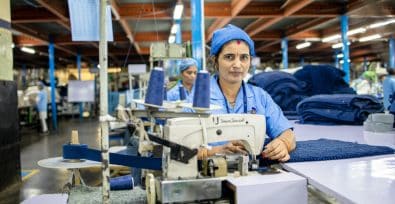
The global garment manufacturing workforce is 60-80% women. Thus, labor rights protections in the sector, or the lack of them, are intrinsically gender-based. Hence, when states and companies suppress labor rights it means women are being disproportionately affected. That’s why when we talk about preventing modern slavery in the garment and fashion industry, it is imperative to look through the lens of gender discrimination.
Empowering women to combat gender discrimination
If you look at the major issues facing garment workers many of them are disproportionately affecting women. That’s because not only are most of the workers women, the industry is rife with gender discrimination. The wage gap that women face in comparison to men in comparable work is persistent. And sadly, for many women working as garment workers, violence and sexual harassment are also heavily prevalent.
In a recent article, Amnesty International writes:
Research in India and Bangladesh warns that male managers and supervisors often bully, harass and sexualize the women who work for them. Women from marginalized communities, such as Dalit women in India or Tamil women in Sri Lanka and Christians in Pakistan, are particularly vulnerable to such abuse.
Additionally, harassment and violence against women are carried out with a culture of impunity. This unfortunately creates a cycle of abuse because it discourages women to report it.
Intersecting identities compounding exploitation
Recent data shows that 75% of all garment workers globally are based in Asia. Many of those are in Bangladesh, India, Pakistan and Sri Lanka. Garment work is seen a one of the few culturally acceptable ways women can earn an income in those countries. Thus, all those workers are predominantly young women who migrated into the city from rural areas. And without the protection of family or community support networks, the women are left extremely vulnerable to abuse and exploitation.
Amnesty International states:
Enabling garment workers’ right to organize and unionize is essential. Unions provide a platform for women workers to collectively address concerns about rights abuses, negotiate with employers and advocate for improved working conditions.
In addition to gender-based exploitation, women who have multiple, intersecting identities including race, caste, migration status or religion face compounding discrimination. And according to Amnesty, attempts by female garment workers to self-organize or advocate for better conditions are often stamped out by employers and even the state. This creates a climate of fear and intimidation, further suppressing freedom of expression. Worse, preventing the right to unionize can fatally hinder workers’ ability to demand justice, accountability, and remediation at all. Leaving them with no choice but to suffer in silence.
Why people before profit matters
Rich and powerful brands and distributors bring needed jobs and foreign investment to emerging economies. And low minimum wages and fewer labor protections go a long way to attract that business. But while governments in many emerging markets view the garment industry as a pathway to industrialization and growth, the risk of modern slavery looms large if workers rights are sacrificed.
Economic growth should not be driven by workers paid poverty wages and denied their fundamental human rights. Stand with us and call on corporations and governments to do more to ensure the goods available for purchase are not costing someone else their freedom.





Freedom United is interested in hearing from our community and welcomes relevant, informed comments, advice, and insights that advance the conversation around our campaigns and advocacy. We value inclusivity and respect within our community. To be approved, your comments should be civil.