


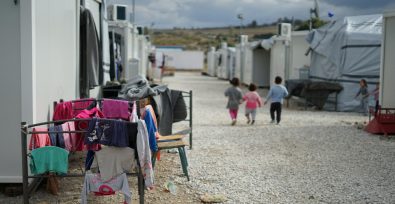
The disbanding of USAID and the sudden, severe cuts to US foreign aid have devastated child protection efforts for Rohingya children living in refugee camps in Bangladesh. Thousands of schools and youth training centers have closed, leaving children without safe spaces, education, or support—and pushing them directly into harm.
Despite claims by the current US administration that “no one has died” as a result of shutting down USAID, a recent study estimates that US funding cuts could ultimately result in more than 14 million deaths. Tragically, millions of those deaths will not be immediate or visible. They will unfold through forced child marriage, dangerous labor, recruitment by armed groups, and trafficking across borders.
“If the school hadn’t closed, I wouldn’t be trapped in this life”
Hasina was just 16 when she was married against her will to an older man who regularly beats her. She says the only moments of relief she gets are when she is completely alone. In those moments, she thinks about the school that once gave her safety, structure, and hope.
Hasina said in an ABC article:
I dreamed of being something, of working for the community, (but now) my life is destroyed. If the school hadn’t closed, I wouldn’t be trapped in this life.
Hasina is not alone. She is one of thousands of children who were previously protected by schools and youth centers—spaces that have now shut their doors following the dismantling of USAID and the loss of critical funding. Children who once spent their days learning are now roaming overcrowded camps with nowhere to go and no one to protect them.
A surge in child marriage, labor, and recruitment
Patrick Halton, a child protection manager with UNICEF, says the consequences were immediate and devastating.
With the funding cuts, we had to downscale a lot in terms of the education. It’s meant that children have not had things to do, and we’ve therefore seen this rise in children being married, children being in child labor.
Halton said in addition to the risk of child labor and forced child marriage there are armed groups with their roots in Myanmar who are operating in the camps. According to Halton, these groups use the refugee camps, now overflowing with youth out of school, to recruit. Halton underlines now that children are not in learning centers and multipurpose centers, their vulnerability to modern slavery is skyrocketing.
Budget “savings” with catastrophic human costs
USAID—dismissed as “wasteful” by the current US administration—accounted for just 1% of the national budget. Its dismantling was framed as a cost-saving measure. Yet US Secretary of State Marco Rubio told Congress that “no one has died” as a result.
The reality on the ground tells a very different story.
Children are increasingly being pushed into unregulated, backbreaking labor. Hundreds of underage girls—some as young as 14—are being forced into marriage. And according to advocates in the camps, many children are facing even worse outcomes.
Showkutara, executive director of the Rohingya Women Association for Education and Development, says her network has documented sharp increases in kidnapping, trafficking, and sexual exploitation since the school closures.
After the school closures, they had no space to play… That’s why they’re playing on the roads, far away from their blocks. There are some groups who are targeting the children.
She warns that even if schools were to reopen tomorrow, for many children it would already be too late. “For those already married or trafficked,” she said, “it’s too late.”
UNICEF confirms that violations against children in the camps have surged this year. Between January and mid-November, reported cases of child abduction and kidnapping more than quadrupled compared to the same period last year. Advocates fear most of those children will never be heard from again.
It is impossible to reconcile these realities with the claim that “no one has died.”
“Better to die if I can’t continue learning”
According to UNICEF, there has also been an eightfold increase in the forced recruitment and use of children for roles in the camps. The agency lost 27% of its funding due to the US aid cuts. Cuts that led directly to the closure of nearly 2,800 schools.
When Mohammed’s education got cut short due to the closures, he started talking to “recruiters” who promised him a job across the border. His parents tried to stop him from leaving, fearing he would be trafficked and tortured as others had been.
He told his father:
It’s better to withstand two years of torture than stay here in a hopeless camp. It’s better to die if I can’t continue learning.
In October Mohammed left his family’s shelter and never returned. His father Ullah said:
If he could have continued his studies, he could have been a teacher, he could have stayed near me. Now he’s left me and I can’t see him. So, I lost my dream, too.
His greatest joy was the sight of his son coming home from school, his backpack on his shoulders. Instead, Mohammed’s backpack hangs on the wall, gathering dust, is his backpack.
The stories of Hasina and Mohammed make one truth painfully clear: when education and protection disappear, exploitation fills the gap. Forced child marriage thrives in crisis—especially when governments withdraw support and look away from the consequences.
Join Freedom United’s campaign to end forced child marriage by demanding stronger protections, sustained funding for education and child protection programs, and accountability from governments whose policies put children at risk.





Freedom United is interested in hearing from our community and welcomes relevant, informed comments, advice, and insights that advance the conversation around our campaigns and advocacy. We value inclusivity and respect within our community. To be approved, your comments should be civil.
Ask the rich Arab nations, China, Russia, and others for help for the children. Why should the USA give money that would be channeled to terrorist groups?