


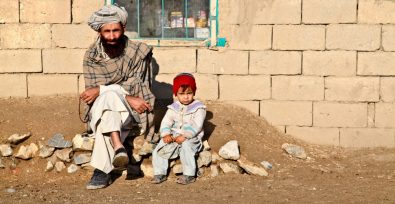
Across Afghanistan, fathers are making a choice no parent should face: sell a daughter, or watch the family starve. Driven to the edge by a catastrophic aid collapse, mass unemployment, and a Taliban government that bars women and girls from education and work, families in some of the country’s most isolated provinces are turning to child marriage as a last resort.
Meanwhile, the Taliban recently removed minimum age restrictions on marriage and claims “silence is consent” effectively legitimizing forced marriage.
“I’m willing to sell my daughters”
Ghor province is one of Afghanistan’s hardest-hit regions, where men gather at dawn hoping for a single day’s work. Most leave empty-handed. For some, desperation has already forced the unthinkable.
Abdul Rashid Azimi wept as he explained his situation to the BBC:
I’m willing to sell my daughters. I’m poor, in debt and helpless.
I come home from work with parched lips, hungry, thirsty, distressed and confused. My children come to me saying ‘Baba, give us some bread’. But what can I give? Where is the work?
He held his seven-year-old twin girls close as he spoke—knowing he may not be able to keep them much longer. He told the BBC he could sell them for marriage or domestic work.
If I sell one daughter, I could feed the rest of my children for at least four years.
Saeed Ahmad has already crossed that line. When his five-year-old daughter Shaiqa needed emergency surgery, he had no money to pay for it. So, he sold her to a relative for 200,000 Afghani ($3,200; £2,400). She will go to live with her buyer’s family at age ten, as a future daughter-in-law. He shared:
If I had money, I would never have taken this decision, … But then I thought, what if she dies without the surgery?
Shaiqa is alive. But her freedom is already gone.
Aid cuts and Decree No. 18
Afghanistan is now facing record hunger. The UN estimates 4.7 million people are one step from famine. More than three in four cannot meet basic needs. And the aid that once kept millions alive has largely vanished. Poverty is so severe that Afghans are actively seeking out traffickers to escape their circumstances. Others are targeted by traffickers who exploit that desperation.
The US—once Afghanistan’s largest donor—cut nearly all aid last year. Other major donors, including the UK, have significantly reduced contributions. UN figures show aid received so far this year is 70% lower than in 2025. Drought has compounded the crisis, affecting more than half the country’s provinces.
The Taliban’s own policies are a key reason donors are walking away. The government bars girls from education beyond primary school and restricts women from most forms of work—effectively halving a family’s earning potential and increasing the perceived value of a daughter as a commodity to be sold.
Further, the Taliban has recently passed a new policy effectively legitimizing forced and child marriages. While the Taliban previously set provisions against forced marriage and a minimum age of 16 for marriage, a new decree has done away with the minimum age. What’s worse, Decree No. 18 states that silence may be taken as consent to marriage.
Yet when asked to account for donors withdrawing, the Taliban government rejected any responsibility, outrageously stating instead that “humanitarian assistance should not be politicized.”
Help end forced marriage
This crisis is not new. In 2024, heartbreaking testimony gathered by the Washington Post revealed girls as young as six sold into marriage in the same desperate conditions. In one settlement, 40% of families interviewed had sold a daughter. The faces change. The crisis does not.
Children like Shaiqa are not statistics. They are daughters with names, bonds, and futures being traded away because the world has looked away from Afghanistan. Governments that cut aid while failing to hold the Taliban accountable for its treatment of women and girls bear responsibility for the conditions that make these sales possible.
Freedom United is fighting to end forced marriage everywhere. Add your name to our petition and demand accountability for every child whose childhood is being sold.





Freedom United is interested in hearing from our community and welcomes relevant, informed comments, advice, and insights that advance the conversation around our campaigns and advocacy. We value inclusivity and respect within our community. To be approved, your comments should be civil.
Marriage means even the poorest men can have slaves. What age were their wives when they got married? Bringing children into the world just to sell them if they’re girls? Please! These men are the problem, and their sons will be the problem! You can’t feed a family? Then don’t force a woman into marriage and rape to starve them.
It seems to be a hopeless situation. The taliban are, in effect, controlling people’s lives. No amount of money is going to change how they view the role of women. It’s heartbreaking to know that men cannot get work, their families are starving, the fathers are selling their daughters so they can eat to stay alive. Women and girls are seen as commodities, told what they can or cannot do. Not allowed to work, imprisoned in a family home. Wear what men tell them. Just slaves! 😭
Its is better for the entire family to starve and die with their dignity intact then for their daughter to go through unimaginable mental and physical torture. This is not Islam but rather a twisted caricature of it, the result of evil men claiming power though violence.
The dilemma of aid is that it allows the status quo in Afghanistan (suppression of women) to continue. The same men selling their girls need to stand up against the Governments edicts. Then the Aid will return.