

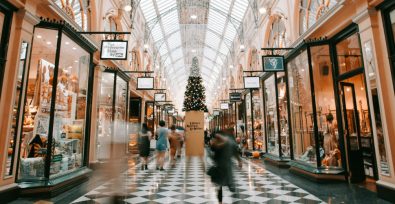
Most holiday shoppers assume the items available in their local stores have been vetted in some way so they are free of labor abuses and exploitation. However, the sad truth is that the holiday score of the “perfect gift” may be coming at a huge cost for others. Due to the growth of China’s labor transfer scheme, goods manufactured across China now often come with a price tag that includes forced labor.
Suffering for sale?
The Uyghur Region in China has long been synonymous with forced labor and labor exploitation. And many consumers and governments have begun rejecting goods coming out of the area for that reason. However, China’s ever-expanding “labor transfer scheme” means Uyghur exploitation is no longer limited to goods made in the Uyghur Region.
Samir Goswami is the director of forced labor programs at Global Rights Compliance (GRC). And Annick Febrey is the principal and cofounder of Better Trade Collective. Both previously worked for the US government on forced labor issues.
As published on MSN, Febrey and Goswami stated:
Most may assume…abuses are distant, confined within the borders of an authoritarian state, (but) our domestic marketplaces tell another story. The suffering of the Uyghur people is ending up in our homes, in our workplaces, and under our Christmas trees — the end result of a state-imposed system of exploitation.
China provides goods to global brands for consumers across the West including the US, Australia and Europe. While across China, the government is operating “one of the largest and most coercive forced labor systems in the world.” Evidence of arbitrary incarceration, family separation and forced labor of Uyghurs and other Turkic and Muslim groups is reported consistently. Yet, the government continuously claims the work assignments are voluntary. However, when your family and your ability to survive are at stake, refusing is not really a choice.
An uncomfortable truth
According to Febrey and Goswami, it’s an uncomfortable truth that forced labor is deeply embedded in global supply chains. So deeply that most shoppers encounter it with “alarming frequency.” And while some try to avoid items from forced labor hubs like the Uyghur Region, many never even know. And in Febrey and Goswami’s view, it should not be the responsibility of the consumer to know. It’s the system that’s broken.
Febrey and Goswami state:
Holiday shoppers should not have to be supply chain experts. No parent choosing a toy should have to wonder whether it was made by someone who was forced to work.
Rather, it is the companies who should be responsible for ensuring that goods produced using forced labor never make it into markets and onto the shelves. To remedy the situation, government oversight and corporate due diligence mechanisms need to be strengthened. Detecting forced labor should be of particular concern when sourcing from areas where the exploitation is imposed by the state.
Holiday joy shouldn’t cost someone else their freedom
A recent GRC report found Uyghur forced labor in a vast range of products. From coffee to mugs, electric vehicles to power tools, household paint to aircraft components, the list goes on and on.
Febrey and Goswami stated:
Governments must enforce existing laws with far greater rigor, and companies must confront the true costs of opaque supply chains by cutting ties with any source touched by state-imposed forced labor.
Freedom United stands beside Febrey and Goswami in saying this holiday season consumers shouldn’t be left to navigate these risks alone. Governments and corporations need to do more to keep Uyghur forced labor out of the supply chains and off our shelves. Because no one’s holiday joy should come at the cost of another person’s freedom.
Stand with us and add your voice to those calling on companies to purge forced labor from their Chinese supply chains and be diligent in searching it out. Together we have the power to push for change.




Freedom United is interested in hearing from our community and welcomes relevant, informed comments, advice, and insights that advance the conversation around our campaigns and advocacy. We value inclusivity and respect within our community. To be approved, your comments should be civil.