


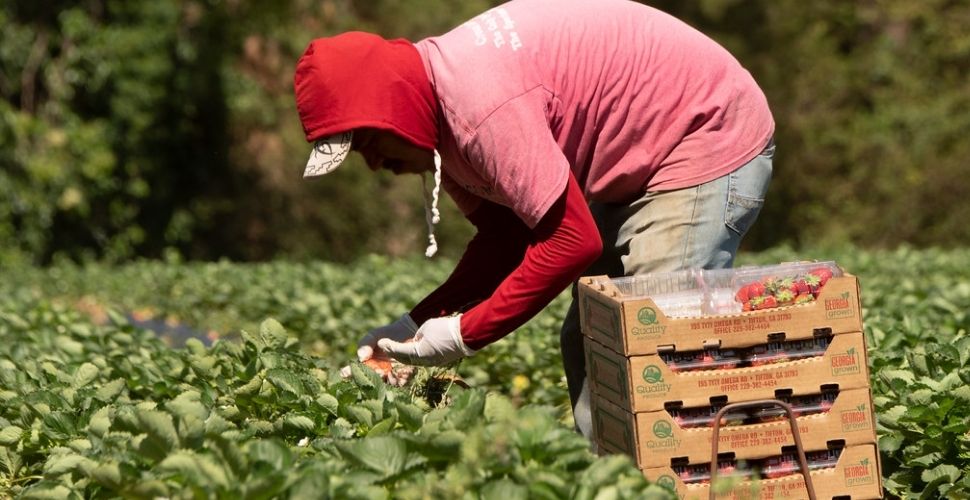
Hazardous child labor in California’s agricultural sector is enabled by weak enforcement and hostile immigration policy. Across the state’s fields, children work long hours picking strawberries, tomatillos, broccoli, and citrus—produce that supplies grocery stores nationwide. Many of them are the children of immigrant workers. Others arrived in the US alone as unaccompanied minors.
Despite California’s strong laws on paper, exploitation is the expected outcome of the current system.
Strong laws, weak enforcement
In the strawberry fields of Salinas Valley, Jose began working at just 11 years old. Now 14, he has already sustained serious injuries to his knees and ankles while transporting heavy boxes over uneven terrain. He earns $2.40 per box and works in triple-digit temperatures, often without access to shade or water—conditions that violate California state law.
Yet, fear keeps him from reporting the abuse. “If I complain, I could lose my job or expose my family,” he said.
According to The American Prospect,
Jose and thousands of other children and teenagers are part of a faceless legion of underage workers in California who put fresh fruit and vegetables on America’s tables. In California, laborers as young as 12 can legally work in agriculture. But many of them toil in punishing and dangerous conditions, and the state is failing to ensure their health and safety.
California maintains some of the strongest labor standards in the US, including legal protections around child labor, heat exposure, and pesticide safety. However, a review of state data reveals a stark gap between law and enforcement.
An investigation by Capital & Main found that between 2017 and 2024, just 27 citations were issued for child labor violations in a state with more than 17,000 agricultural employers. Less than 10 percent of fines were collected.
And the violations that slide under the radar are immense. Angelica began picking tomatillos at 11. At 15, she earns $3 per five-gallon bucket, sometimes bringing home only $9 after several hours of physical labor. She kneels for long periods on hard, dry soil, her hands repeatedly exposed to pesticide residue on the leaves. Meanwhile, Lorena and Alexandra reported murky drinking water, overflowing toilets without soap, and direct exposure to chemical sprays that caused rashes, burning eyes, headaches, dizziness, and frequent nosebleeds.
Some children return home shaking. Others vomit from heat and chemical exposure. Several describe fingers blistering and skin peeling after a day in the fields. And still, they return the next morning.
Immigration policy deepens vulnerability
Many children working in these fields live in households directly impacted by the US immigration enforcement system. Therefor, families worry that speaking out will lead to job loss, detention, or deportation. As a result, abuse frequently goes unreported.
“The fear is constant,” said a father in California’s Central Valley to The American Prospect. “If one of us is taken away, we lose everything.”
This is how immigration policy becomes a tool of labor control. Workplaces turn into zones of surveillance, and silence becomes a survival strategy. The result is a workforce made invisible—and therefore exploitable.
Families are not sending children into the fields by choice. They are responding to a system that refuses to pay adult agricultural workers a living wage. Children fill the economic gap left by structural inequality.
Social worker Miriam Andres explains:
What really needs to change is how much agricultural workers get paid—so minors don’t have to help out their parents.
Yet, rather than strengthening protections or raising wages, lawmakers in several parts of the US are working to roll them back.
A national warning sign
California’s failure to enforce its own laws should be viewed in the context of a broader national trend. Across the US, child labor violations are rising at the same time that some states are moving to weaken restrictions around age limits, work hours, and employer accountability.
These changes do not modernize labor laws. They normalize exploitation—particularly for migrant children and children of undocumented workers who already face systemic barriers to protection.
As enforcement failures mount and corporations continue to profit, Freedom United is urging lawmakers at both the federal and state level to strengthen child labor protections. Without strong protections, the exploitation of children will remain a built-in feature of the agricultural supply chain.




Freedom United is interested in hearing from our community and welcomes relevant, informed comments, advice, and insights that advance the conversation around our campaigns and advocacy. We value inclusivity and respect within our community. To be approved, your comments should be civil.