

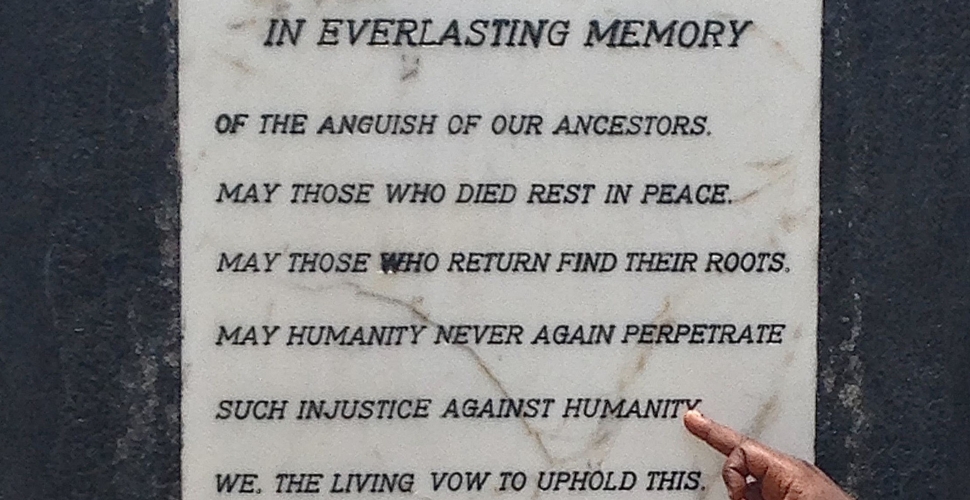
The Transatlantic Slave Trade was rooted in race. It solidified the concept of white supremacy and the systematic displacement of millions of Africans. Today, August 23, we remember the 12.4 million human beings that were loaded onto slave ships and carried through the ‘middle passage.’[1]
We remember the 1.8 million people who died while on the Atlantic Ocean, who were cast overboard to the sharks that followed the wake of the ships. And we remember the 10.6 million people who survived and were forced into the vicious plantation system that built the Americas.
August 23 is also a day to remember how the enslaved rebelled and resisted in ways unimaginable, and the history of the abolition movement. It is the anniversary of the day that self-liberated enslaved people on the island of Saint Domingue (today Haiti and the Dominican Republic) rose up against colonial rule, and played a crucial role in the abolition of the transatlantic slave trade.
The danger of turning a blind eye
Yet, instead of remembering and repairing, almost half of the states in the U.S. are working to silence discussions on race and the history of racism in the classroom. Legislation is being considered or has passed to ban the teaching of “critical race theory” and “any doctrine or theory promoting a negative account or representation of the founding and history of the United States of America.”
Presidential candidate Ron DeSantis is leading the charge. He is encouraging controversial changes to Florida’s educational curriculum stating that enslaved people “developed skills that could be applied for personal benefit.”
Meanwhile we’re hearing loud cries of outrage about the injustices of racism. Footage of George Floyd murdered at the hands of three white police officers drew visceral anger and powered calls for change.
How the world is stepping up
To understand where we are today, we must understand where we have come from. Initiatives around the world are digging deep into history and drawing direct links from the past to the present. Slavery North is a research institute that looks at forgotten and overlooked histories of slavery through historical evidence. This initiative recovers cultures, experiences, lives and resistance of enslaved people.
Institutions, from universities to banks, around the global north are exploring how they have benefited from the profits of historical slavery, some proposing reparative actions to address colonial legacies.[2]
Public figures such as the family of Victorian era British prime minister William Gladstone, are travelling to Guyana to apologize and pay reparations where they benefited as one of the largest historical slave owners in the British West Indies.
King Charles III of the United Kingdom has also committed to deepen his understanding of slavery’s impact and has granted researchers full access to the Royal Archives. The study that is expected to be completed by 2026.
Honor history by acting today
Freedom United believes that these initiatives are essential to help bridge the gap in understanding how historical slavery has laid the foundation for modern slavery today. That understanding informs our need for solutions that change our current systems and structures, that enable a future without extreme exploitation.
Our campaign, Amend the Thirteenth shows the direct connection between historical slavery in the United States and prison slavery via the constitution written during the abolition of slavery in 1865.
Sign the petition to honor and remember those who were enslaved in the Transatlantic Slave Trade and show those who are enslaved today under the 13th Amendment that what was wrong in history, is wrong today.
Radical change is possible. Donate to continue this fight, pushing for the kind of change that history shows us change can be achieved.
Explore our in-depth analysis of why historical slavery is relevant to today’s fight.
Footnotes:
[1] The voyage from Africa to the Americas was called the Middle Passage. Slave ships usually took between six and
eleven weeks to complete the voyage, made large profits by carrying as many people as possible across the Atlantic
to sell at auction. Enslaved people were chained and forced to stay in the underbelly of the ship for days in
unbearable heat, foul air, and little oxygen. Many did not survive the middle passage; https://www.bbc.co.uk/bitesize/guides/zqv7hyc/revision/8
[2] See McGill University’s report and University of Glasgow’s report.



Freedom United is interested in hearing from our community and welcomes relevant, informed comments, advice, and insights that advance the conversation around our campaigns and advocacy. We value inclusivity and respect within our community. To be approved, your comments should be civil.
A few things we do not tolerate: comments that promote discrimination, prejudice, racism, or xenophobia, as well as personal attacks or profanity. We screen submissions in order to create a space where the entire Freedom United community feels safe to express and exchange thoughtful opinions.